A multi-agentic, data-led approach to provide a readily consumable information layer on decades of top-tier search experience.
When combined with our insight and specialist market knowledge, the result becomes a true intelligence-led leadership advisory service.
Click into the situation that matches the conversation you're having.
One proprietary intelligence platform beneath all four. A single data lake, multi-agentic processing, microservice connectivity to global research — the synchronous interface between data and advisory.
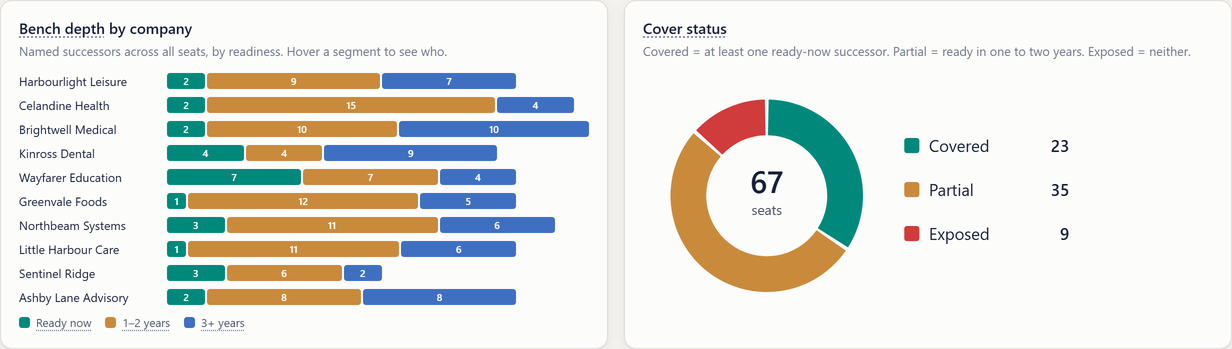
The combined leadership team appointed with data-led evidence and insight — not on negotiation, nor on inherited evaluations carried over from either prior organisation. A digital, real-time view of team dynamics, quantified in the platform's architecture rather than asserted in a deck. Equally true when a portfolio of companies is being consolidated under a single operating model.
The first ninety days set the tone for everything that follows. Retention decisions, culture decisions, structural decisions — all of them benefit from the same evidence base, applied identically to every leader in scope.
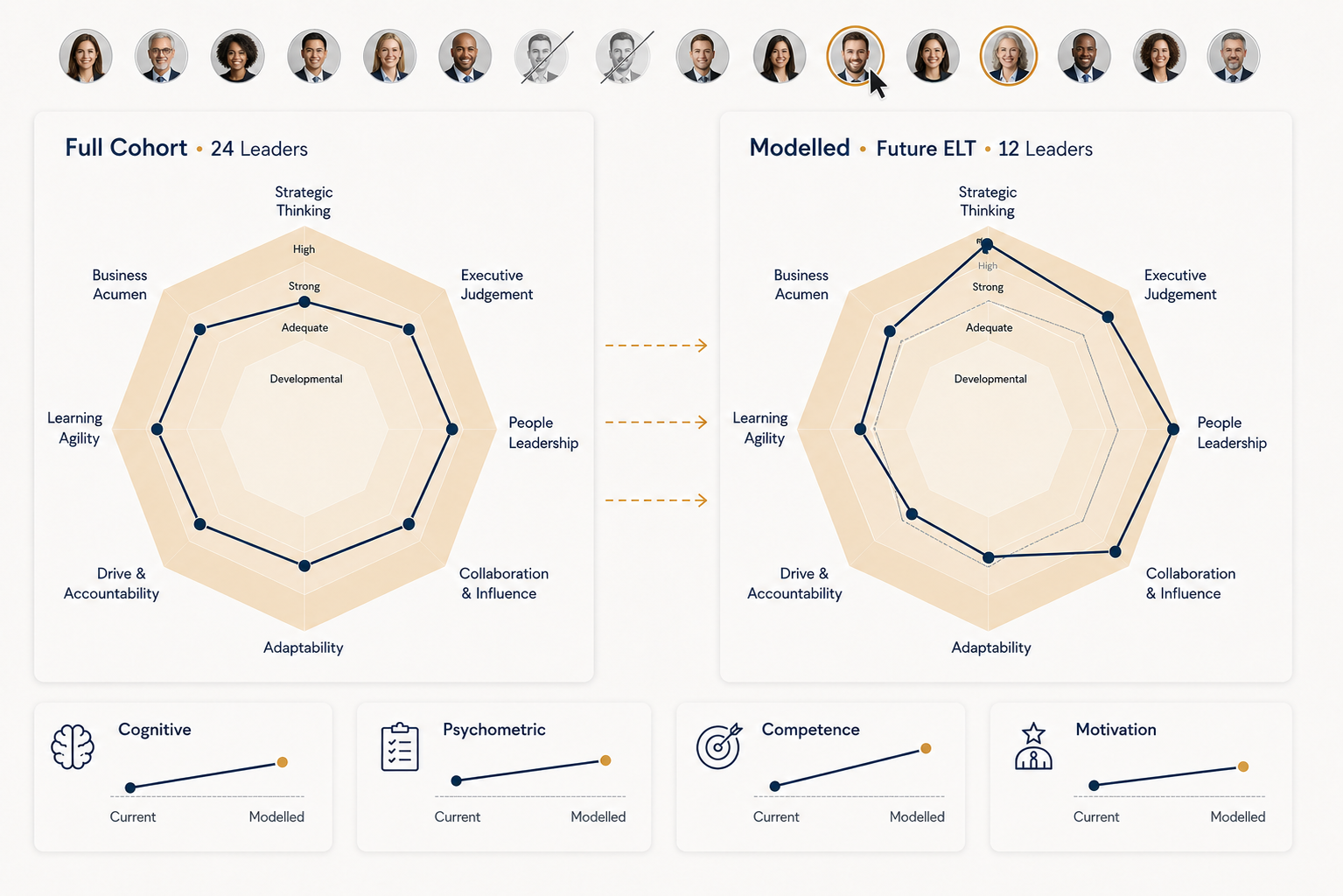
Where traditional integration relies on inherited evaluations and the politics of who-knows-whom, this turns the combined team into a single live data set — every leader visible against the same metrics, every relativity quantified, every scenario modellable on the fly. The Board sees the team as a system, not a stack of CVs.
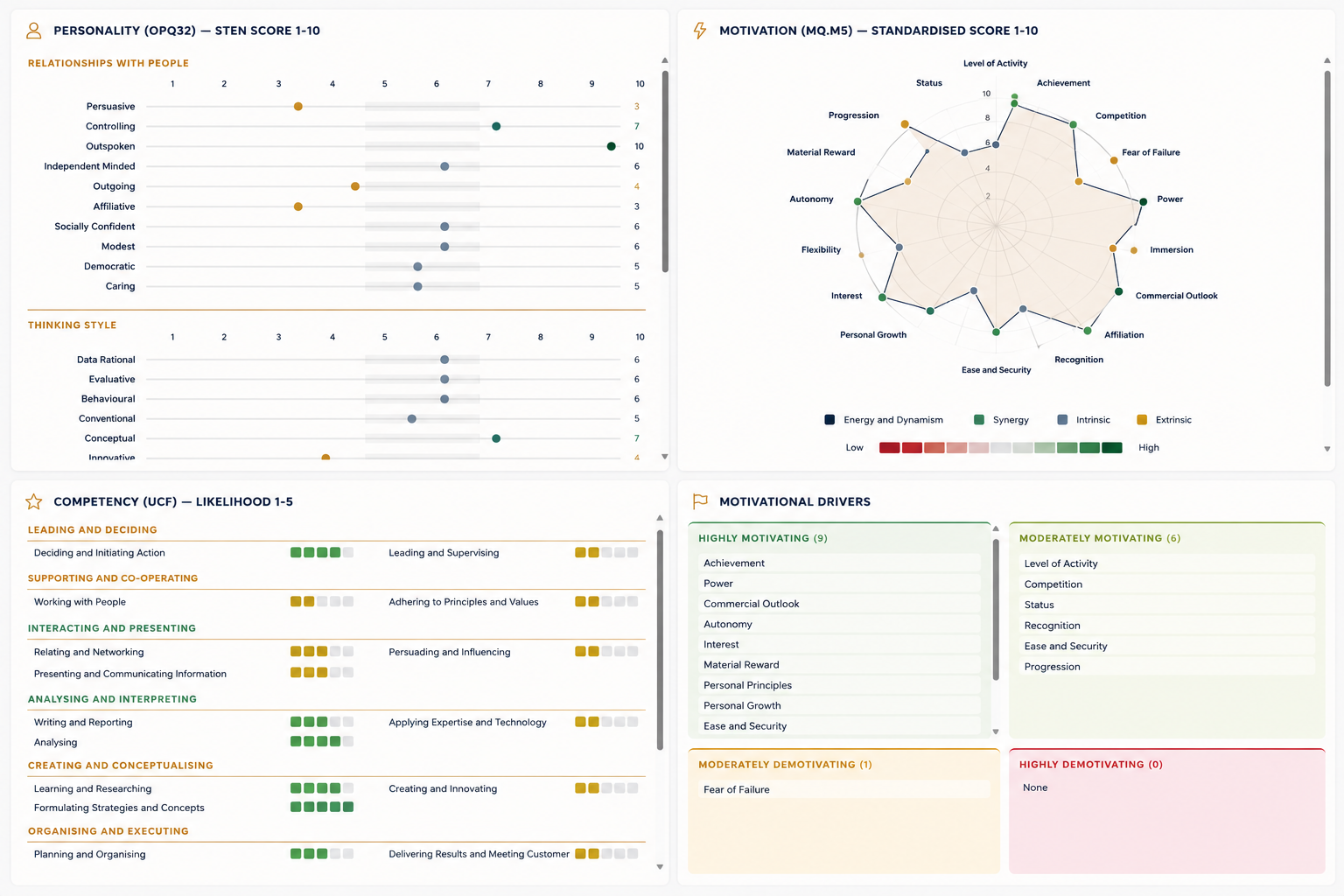
Each executive evaluated across the four domains where leadership effectiveness, fit and potential actually live — cognitive, psychometric, competence and motivation. A dynamic team assessment and modelling exercise to visualise every eventuality. Triangulated through dedicated instruments plus a structured competency interview. Two consultants in every conversation.
Dynamic, not static. The whole leadership team in a single live view — segmentable, scenario-modellable, refreshable as the organisation evolves.
v2 note: this is the page that needs to feel like a live platform. Today it's a flat capture; the next iteration links out to a recorded demo or embeds a slider between filtered/unfiltered states.
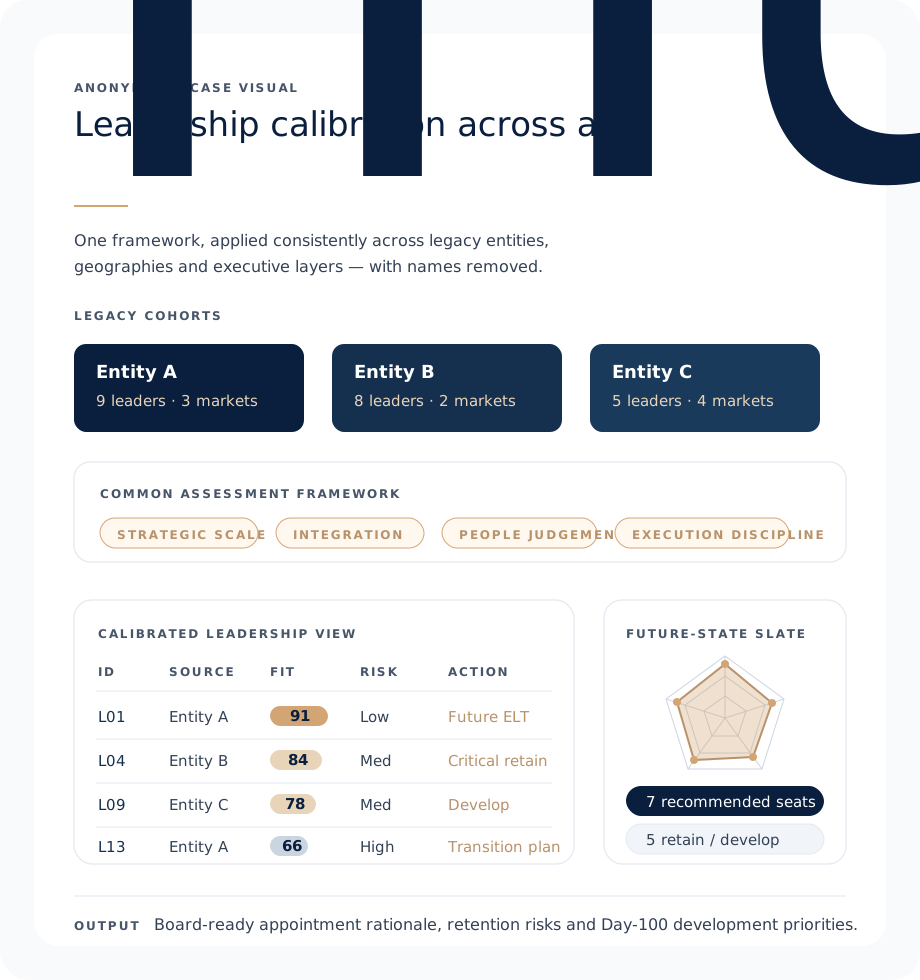
Anonymised. A consolidated leadership team built on evidence rather than on the politics of either prior organisation — across multiple business units and geographies, on one framework, in twelve weeks.
Combine the executive teams of two legacy organisations — and their underlying business units across multiple geographies — into a single future-state ELT. No inherited evaluations. No "this is how we did it on our side". One assessment framework, applied identically to every leader at the top two levels.
Four domains, four stages, twelve weeks. Two consultants per interview: one with deep market expertise, one with assessment specialisation. Same instruments, same scales, same competency framework — across every executive in scope, regardless of which legacy organisation they sat in.
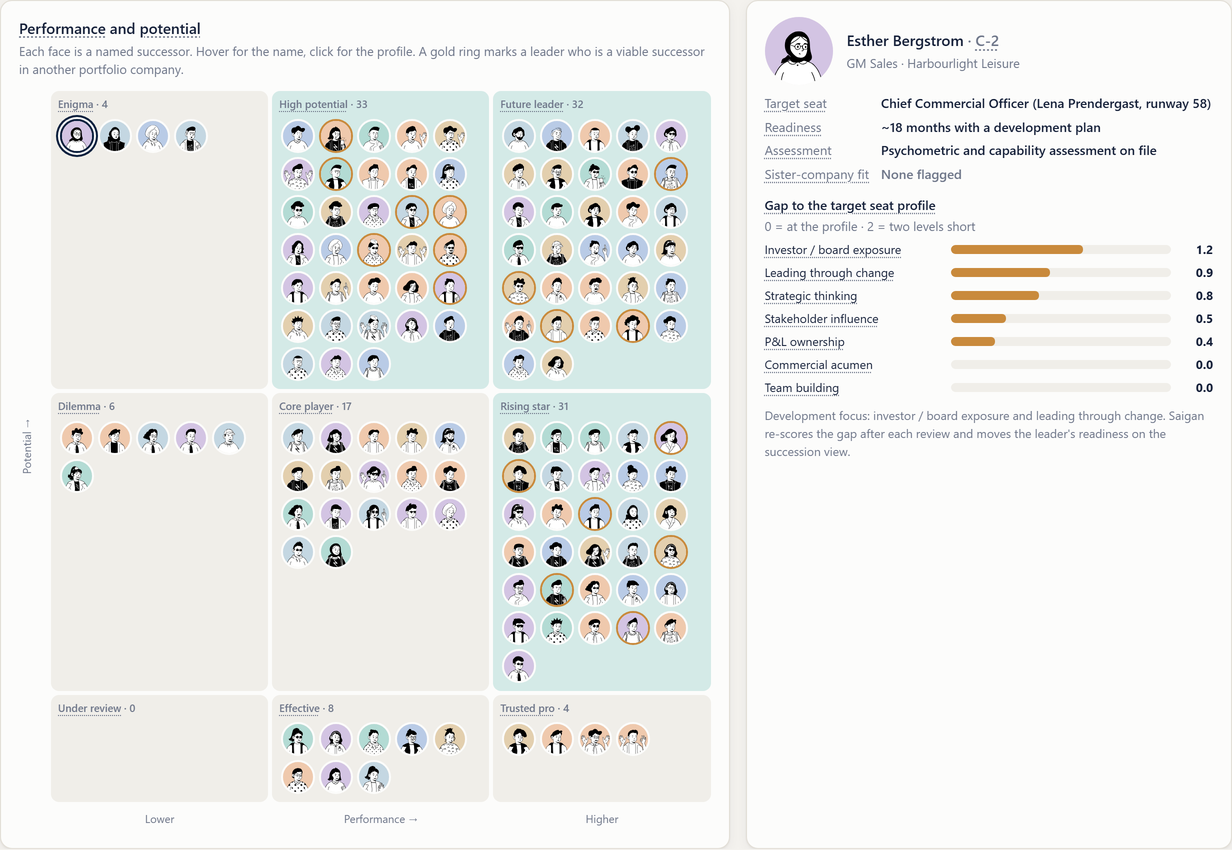
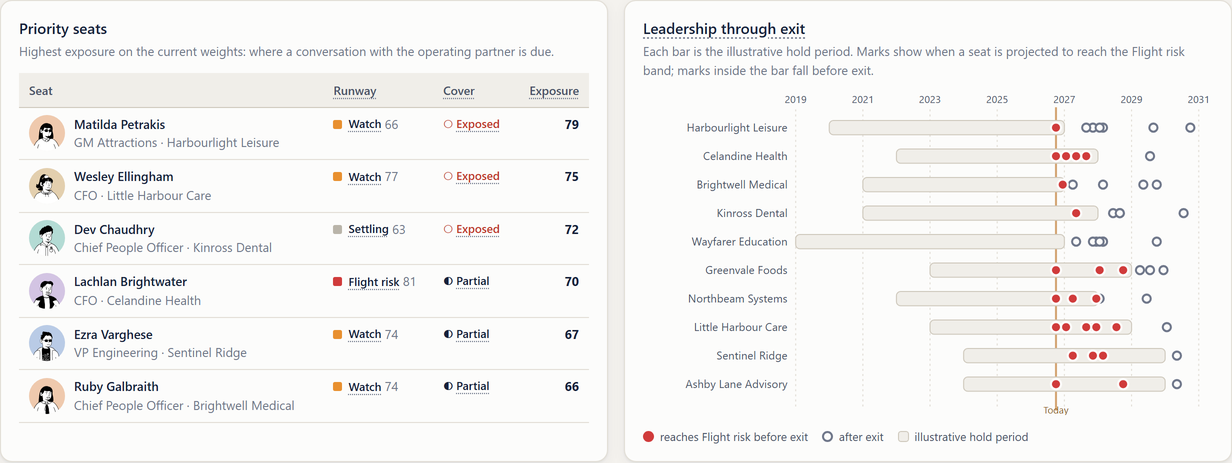
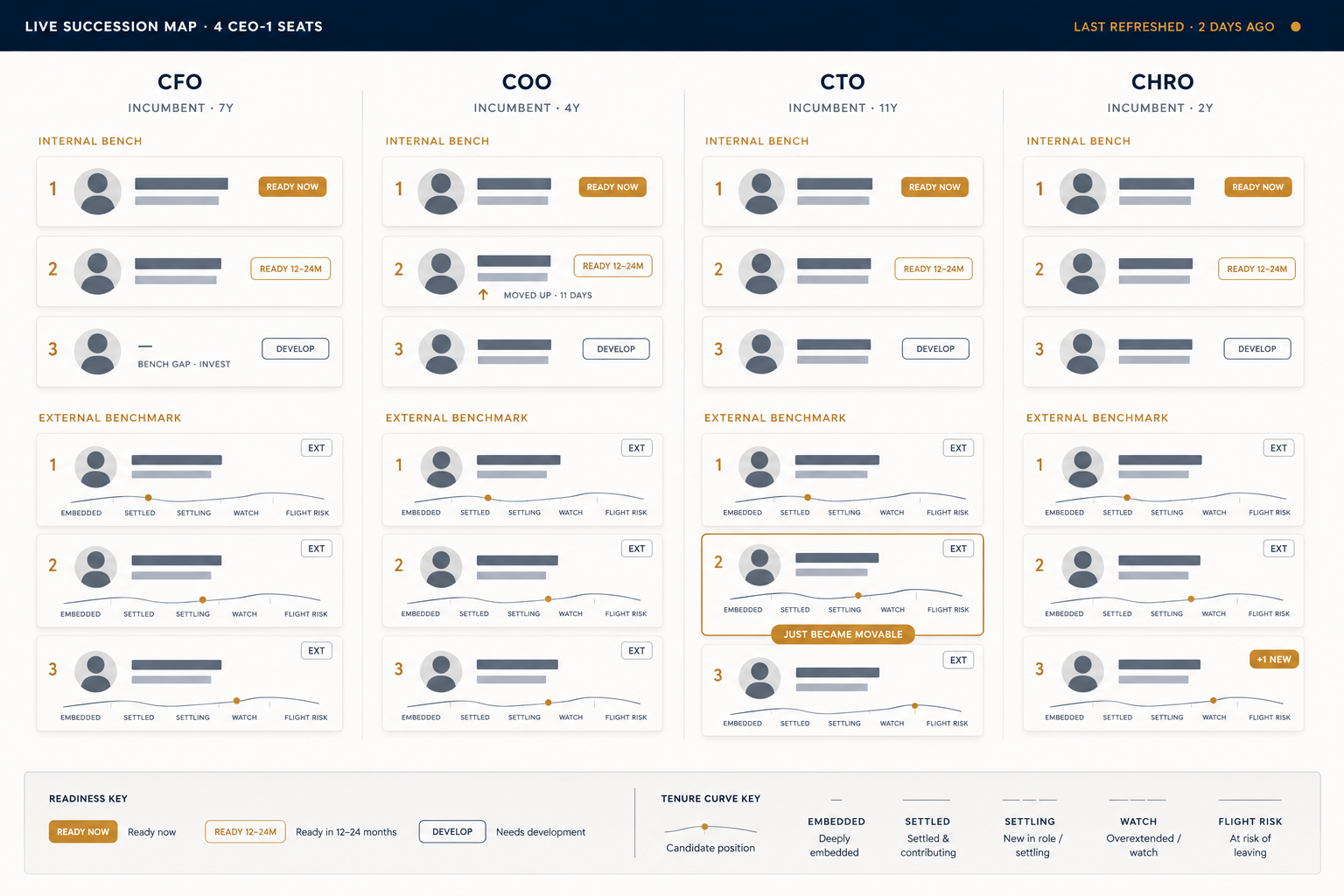
Succession is a relationship, not an event. Reactive succession is expensive and limits options. Proactive succession is a continuous mapping engagement that turns "we've got someone in mind" into a benchmarked, refreshable bench — internal and external — that the Board can interrogate.
The people two and three steps below the CEO matter as much as the CEO — and a list of names in a deck isn't a succession strategy. The Board needs to see the live universe, with internal candidates benchmarked against external reality, and the early signals when the external benchmark moves.
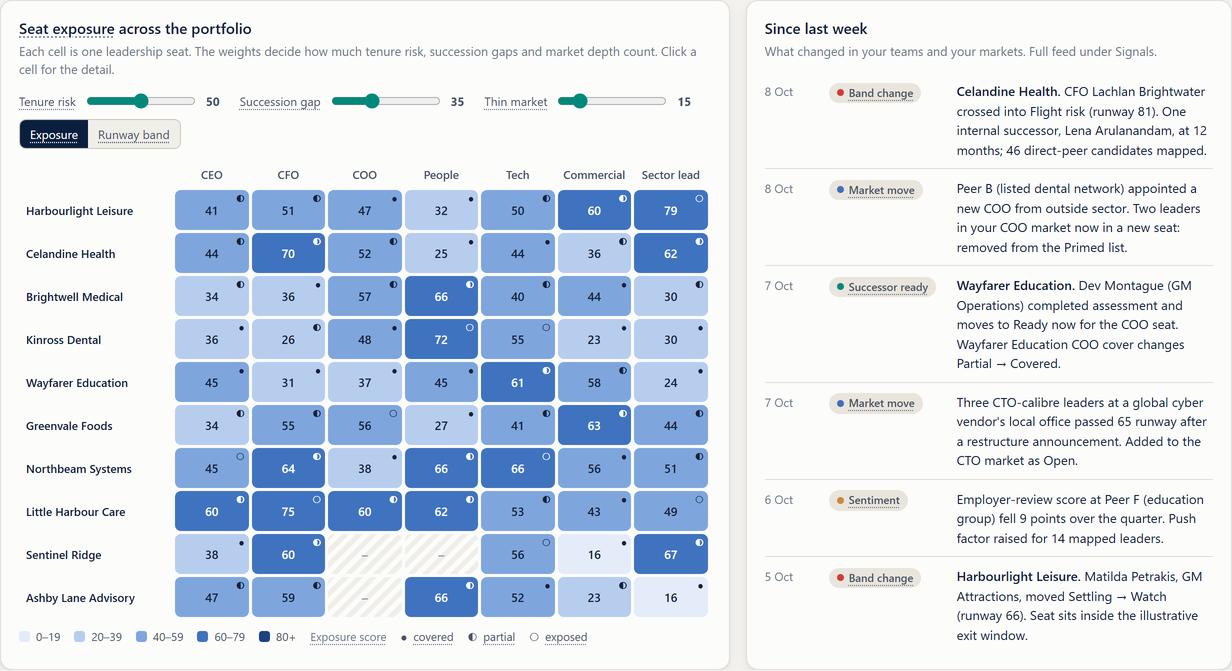
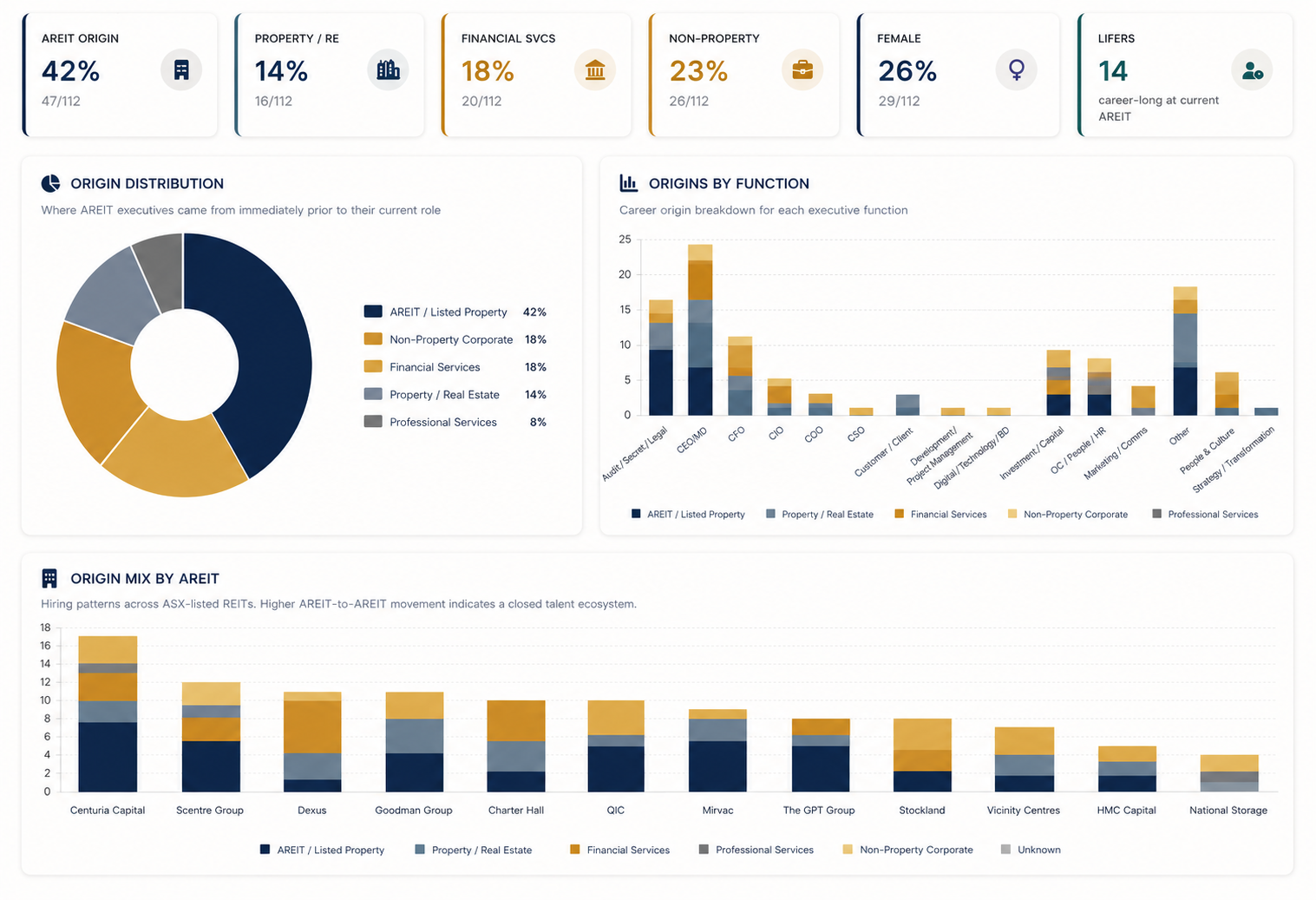
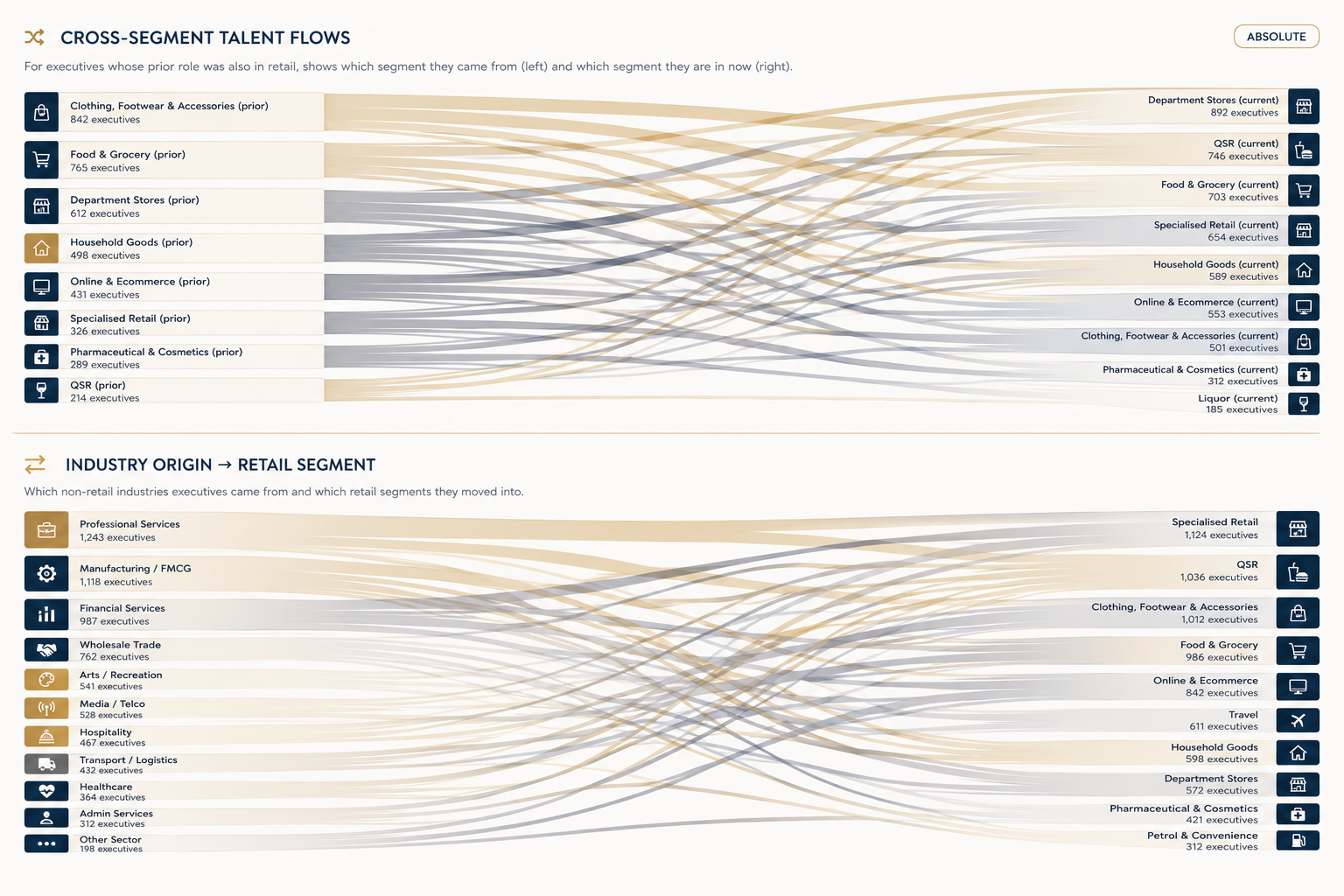
Where the executives in your succession universe came from, where they're going, how stable they are, and who you've never spoken to but should.
An aggregate read of the peer set — surfaces which competitors are about to lose senior leaders, and where the talent will land when they do. "The biggest succession event waiting to happen sometimes sits next door."
Anonymised. A 24-month engagement mapping the leadership universe for an integrated business preparing for a sequence of CEO-1 transitions.
An ELT whose dominant career origin sat heavily inside its own sector — perfectly adapted to the last decade, increasingly mismatched against the platform the business was becoming. The question wasn't who comes next, it was where do they come from.
A live succession map refreshed quarterly. A named pipeline against every CEO-1 seat. A target list for proactive outreach before roles became live — and the early signals when an external target's tenure curve flagged "movable".
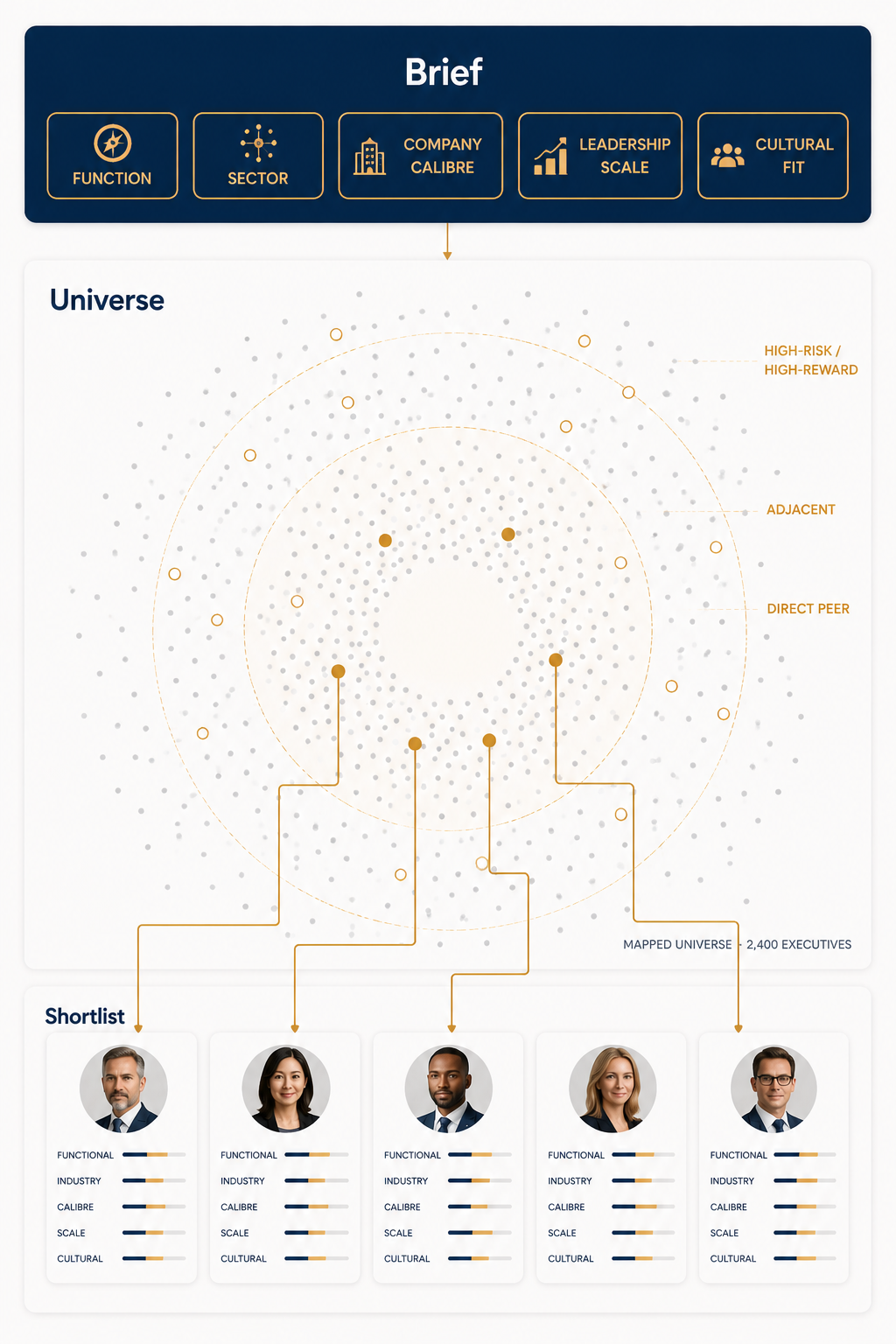
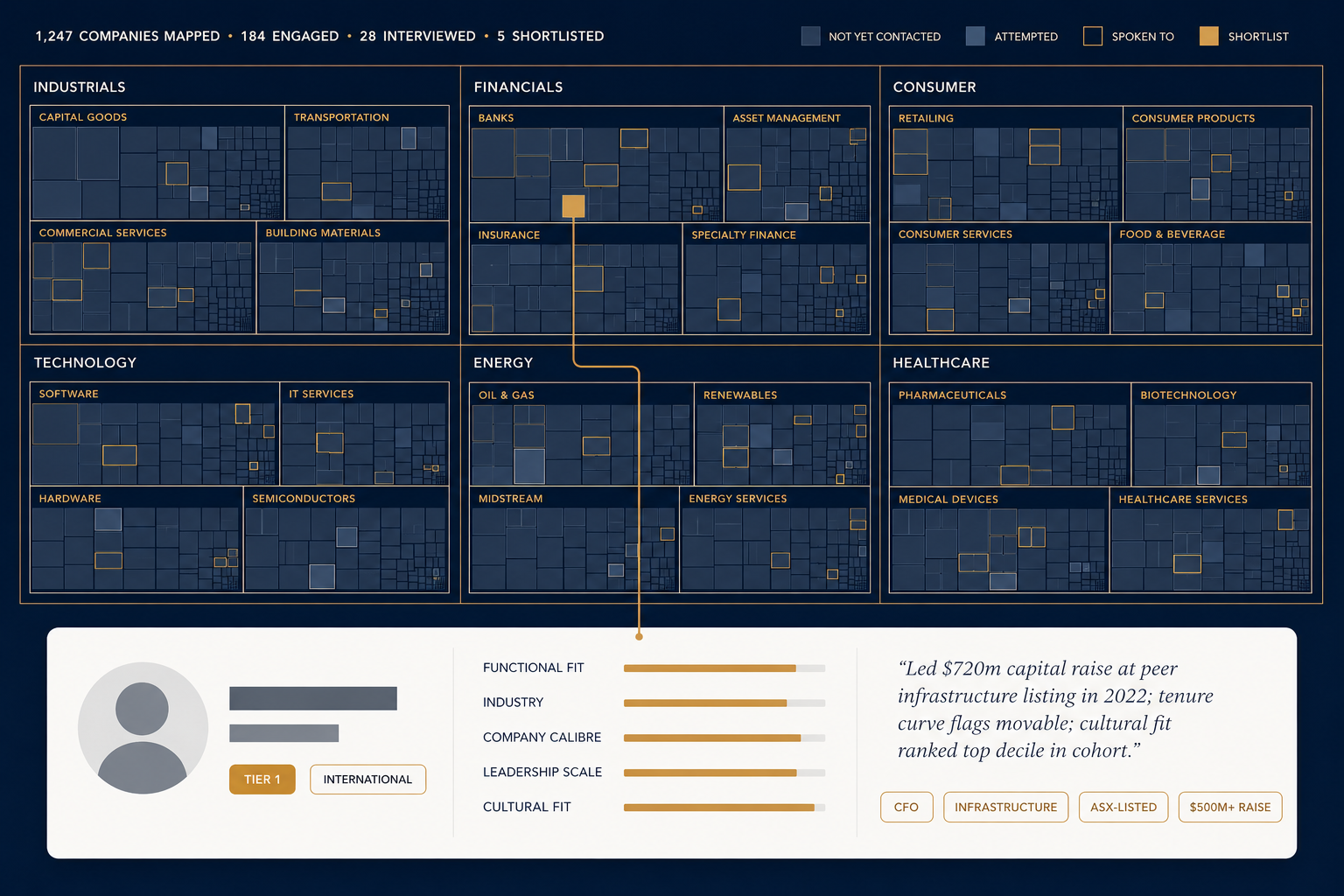
A defensible shortlist — built on the entire mapped market, not the seven names you see on a shortlist. AI underpins the research; partner judgement runs the conversation. The resulting advice is enriched by insights.
The Board doesn't want to hear "we know everyone in this space." It wants to see the evidence behind every name on the shortlist — and the names that didn't make it, and why. The search firms that built their reputation on the curated seven are quietly being displaced by the ones who can show the whole map.
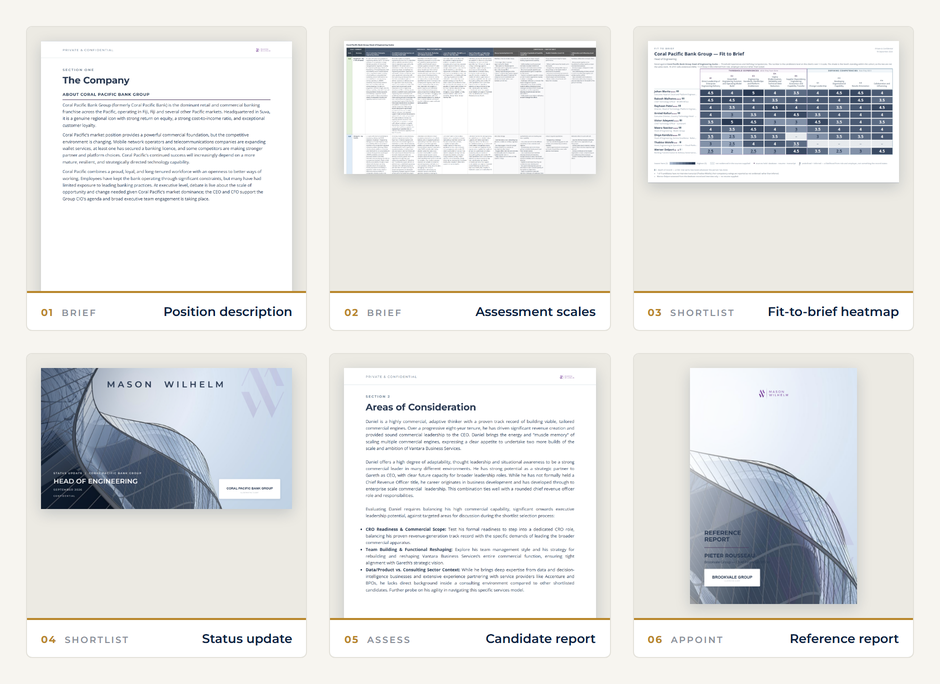
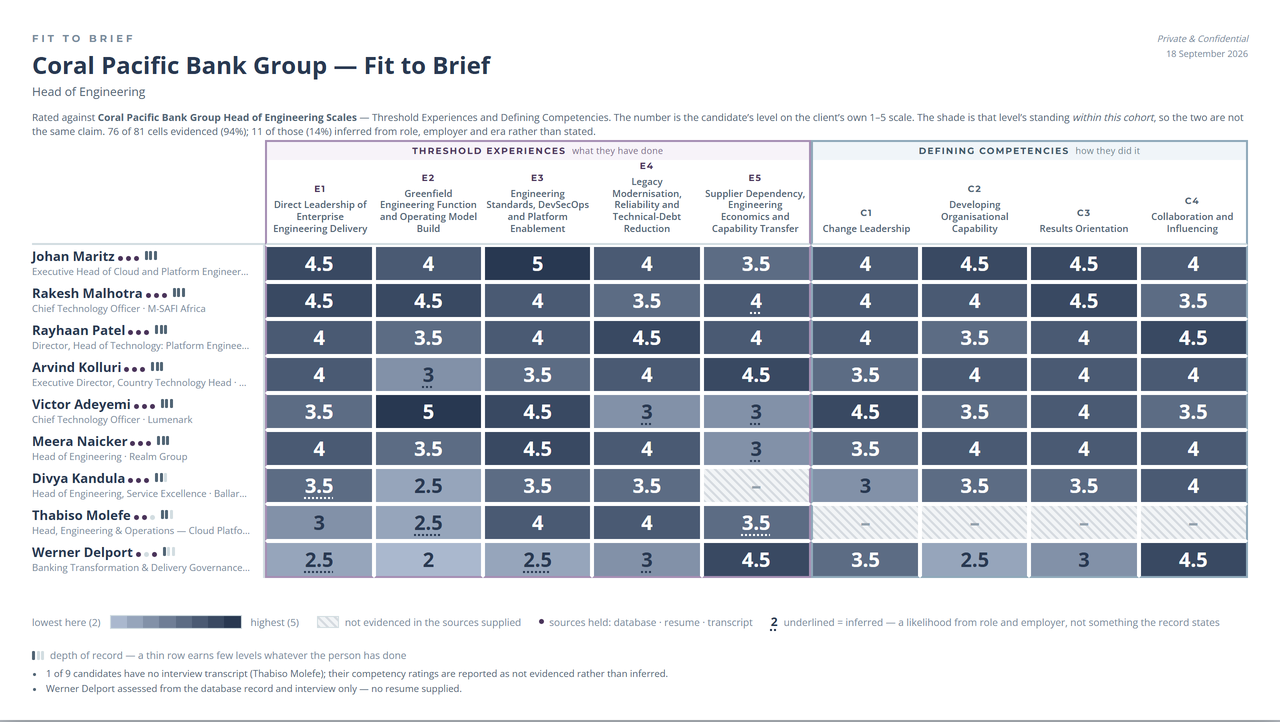
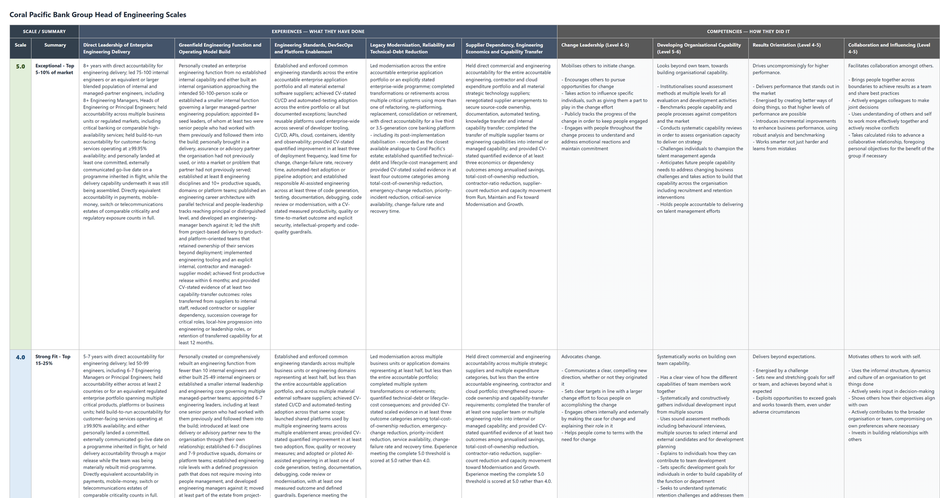
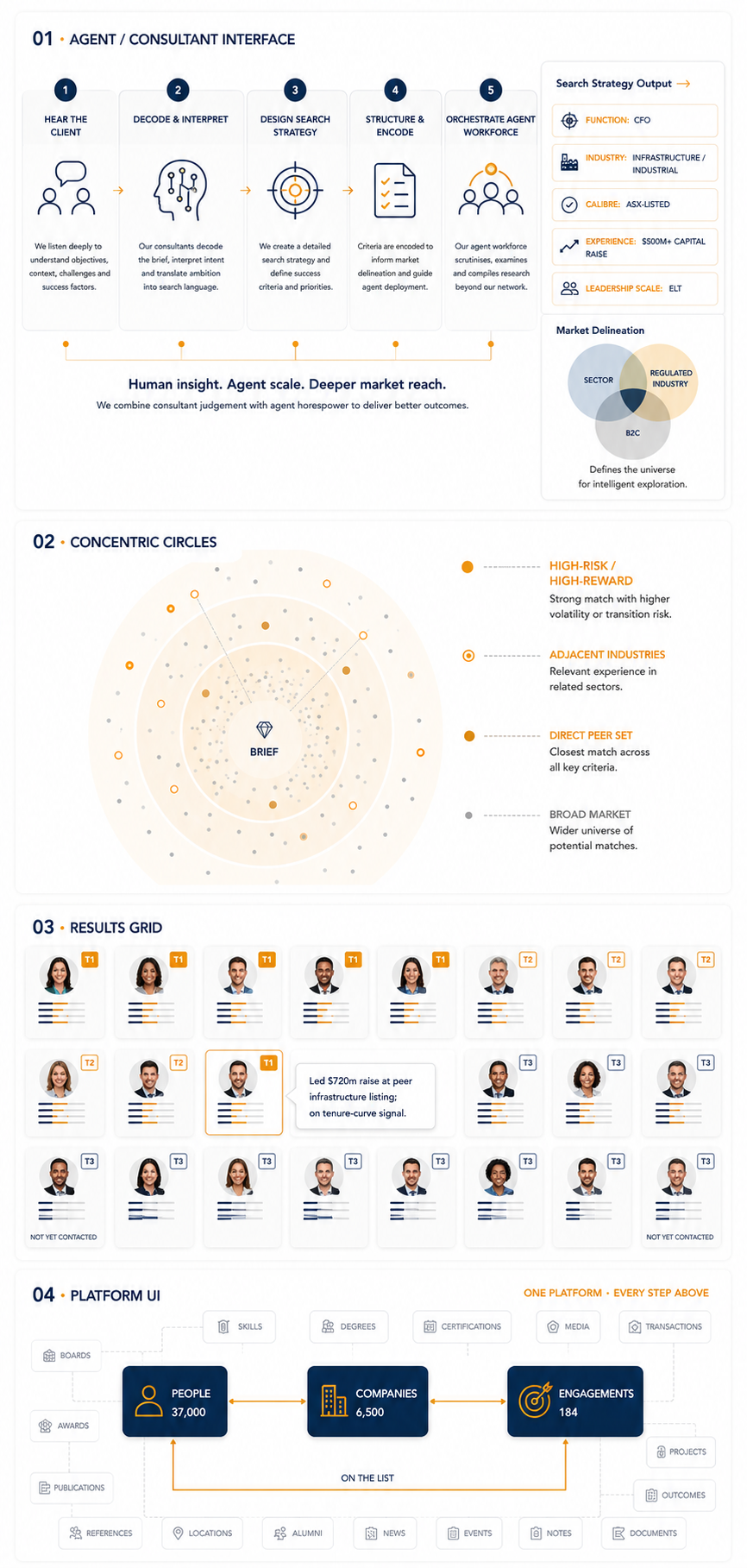
The agent UI, the likelihood curve, the results grid, the platform beneath them. Sequential, transparent, calibrated.
Clients should not have to wait for the final shortlist to understand the work. The process is visible as it develops: brief calibration, mapped universe, scoring logic, coverage and evidence.
The point is transparency without clutter. Each name has a reason, each gap has a status, and the final recommendation lands with enough context to be defended at the board table.
Anonymised. Two engagements — one in Egypt, one in Australia — same methodology, same evidence pack, same pace. Geography is a variable, not a constraint.
A senior appointment in a market with limited traditional search infrastructure. Candidates needed to be sourced internationally, scored consistently, and presented to the Board on the same evidence base any domestic hire would receive.
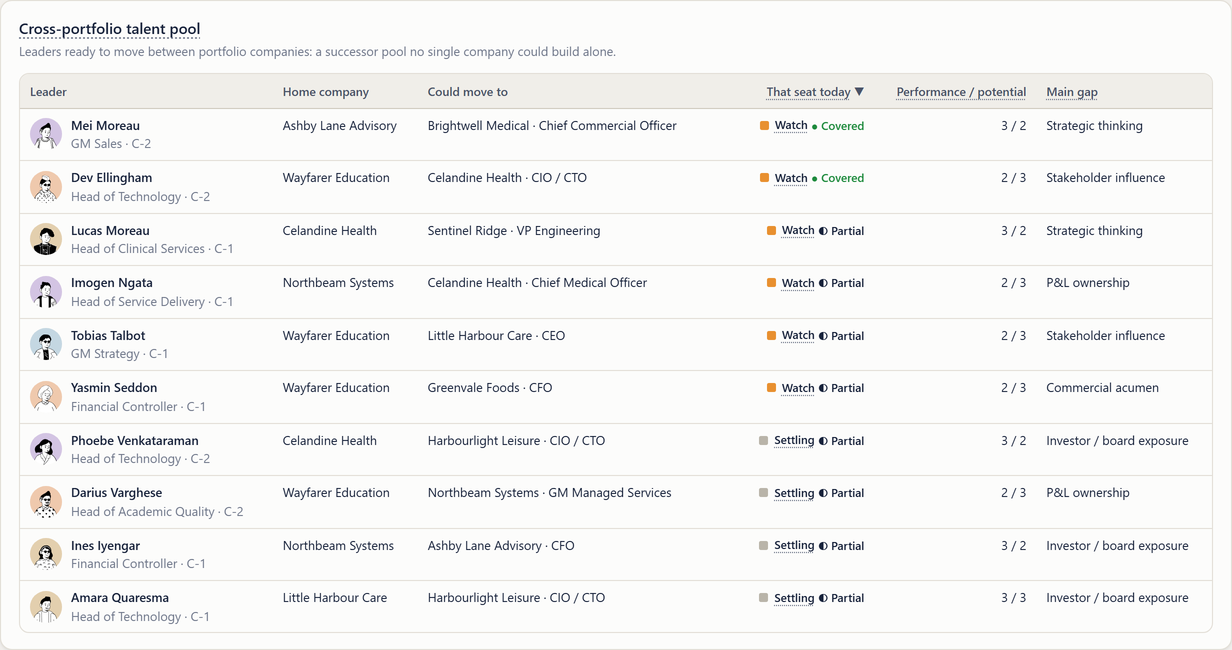
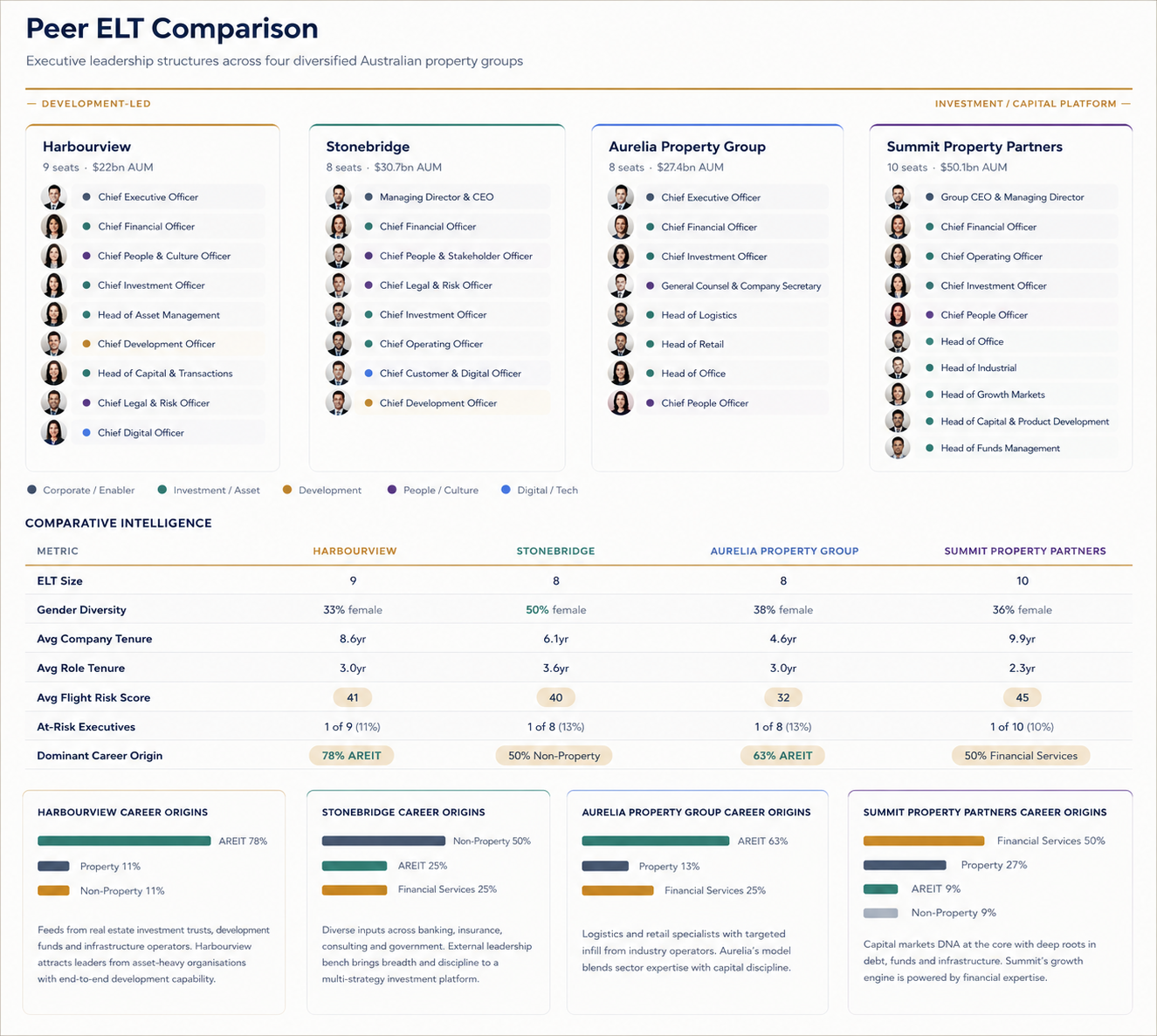
"How does our ELT compare?" · "What skillsets are required to fulfil our future strategy?" · "Where will the next CFO come from?" · "Who's vulnerable across the sector?" Strategic questions that need the whole mapped leadership market for an answer — not anecdote, not the same seven names, not a generic sector report.
The Board's biggest people questions sit upstream of search. Before the role is open, the answer to "where will they come from?" shapes strategy. Before a competitor moves, the signal that an executive is "gettable" changes the conversation. This is the layer above the appointment — the leadership market understood as a system.
This is not generic sector intelligence — that's a Gartner conversation. This is leadership intelligence: the people, the movements, the benchmarks, the structural patterns.
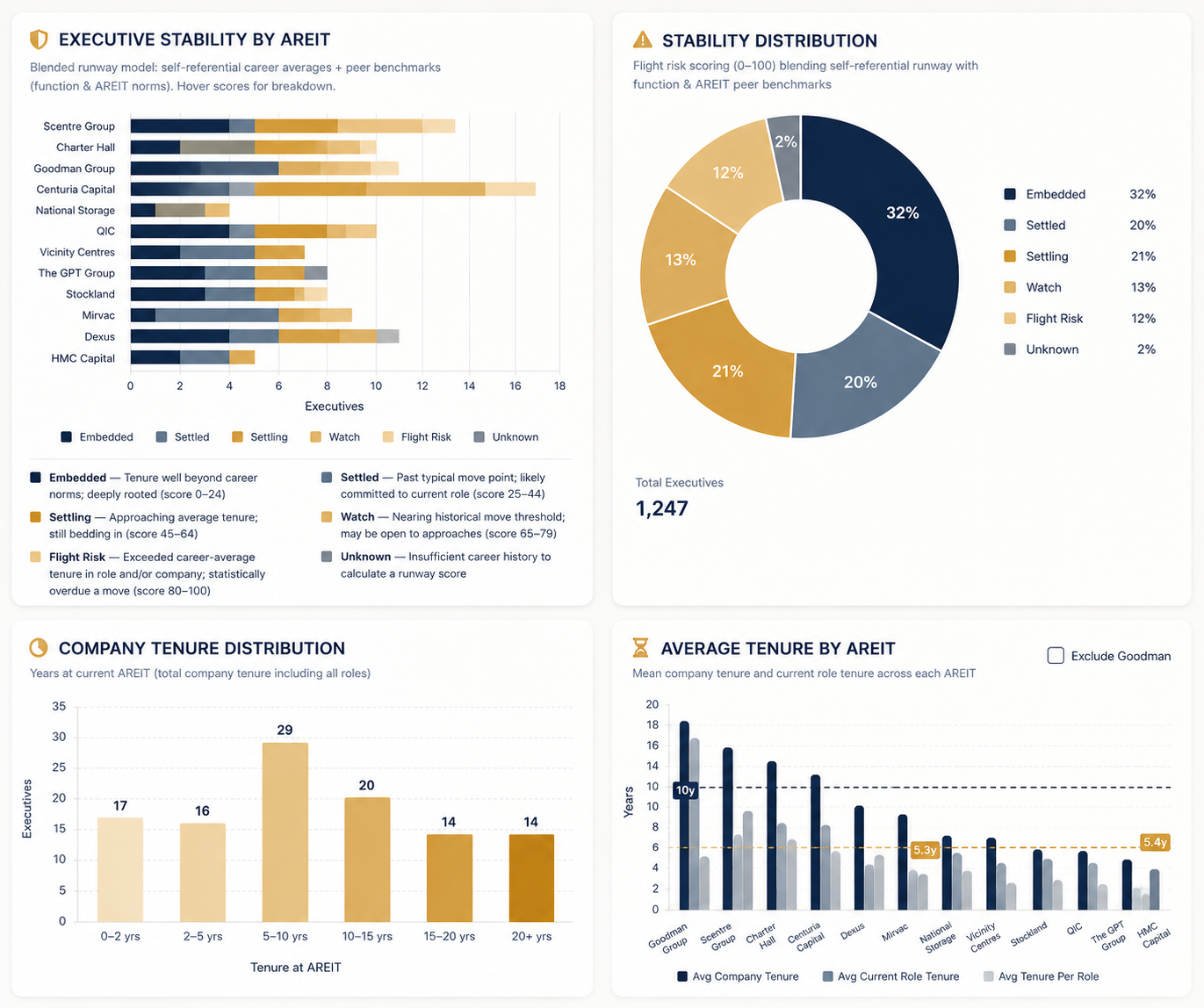
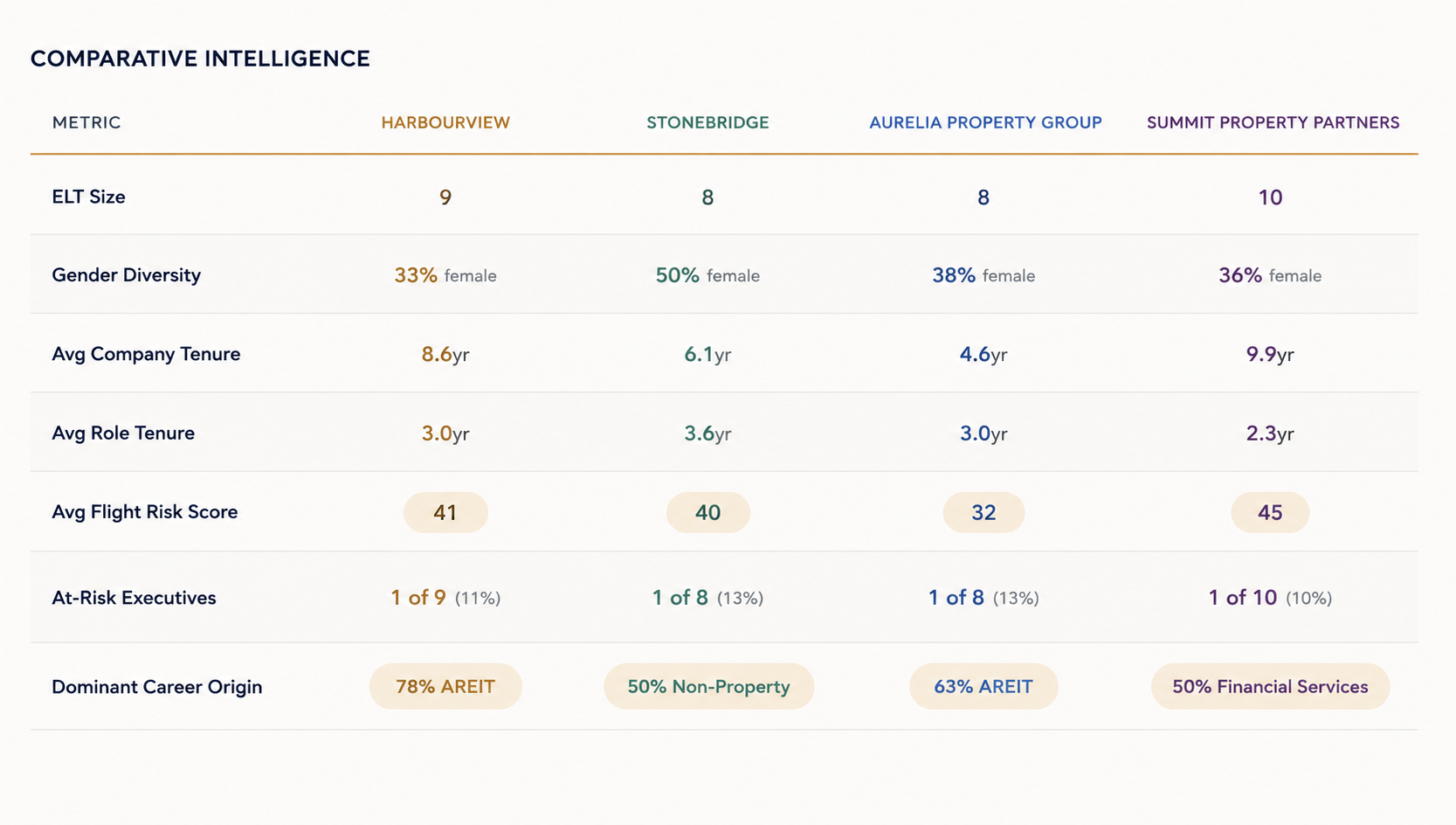
Mapped, benchmarked, refreshable. Every senior leader across the peer set — career origins, tenure, stability scoring, flight risk — filterable by entity, function, geography and gender.
This isn't a Gartner report. It isn't sector economics or industry forecasts. It's leadership-shaped intelligence — the people who lead the businesses in the sector, the patterns of their careers, the structural choices their organisations have made.
The same platform that powers Search and Succession produces this — refreshable, filterable, and as deep as the brief demands.
Anonymised. An integrated business preparing to scale beyond its traditional operating model needed to know whether its leadership pipeline matched its destination — and how it sat against peers who had already made the shift.
The business was rotating its capital allocation away from its historical engine and toward platform-style growth. The Board needed to understand whether the leadership structure reflected where the business had been, or where it was going.
The Board moved from "we need to be more diverse in our hiring" to "here are the three sectors we should be hiring from, and here are the names already on the move." Strategy became actionable people-strategy in a single engagement.
One proprietary platform beneath all four situations. Not an appendix — what the firm is built on. The same intelligence layer flows through Integration, Succession, Appointments and Market Intelligence, which is why the work is consistent, evidenced and refreshable.
Three layers. Four engine components. One coherent process from brief to board pack.
Not data for data's sake. Not AI for AI's sake. The science of search is now AI-augmented; the art remains human. Partner-led judgement, on evidenced ground.
Search firms have long claimed trust by virtue of being known. The reputational shortcut goes: "they're well-known, so the seven names they bring are the right seven." That worked when nobody could see the rest of the market. It doesn't work now.
v2 note (Jack): is there a more eloquent way of saying this rather than taking a shot at the big firms?
We don't claim trust — we show it. We share the methodology, the evidence trail and the rejected names alongside the chosen ones. Real trust is built on a truthful set of data, with partner-led judgement layered on top of facts, not just opinion. Then opinion, on top of facts.
The flow that turns a query into a decision the Board can defend.
Closing-page candidates: partner contact strip · QR code to live HTML hub · podcast version link (per meeting).